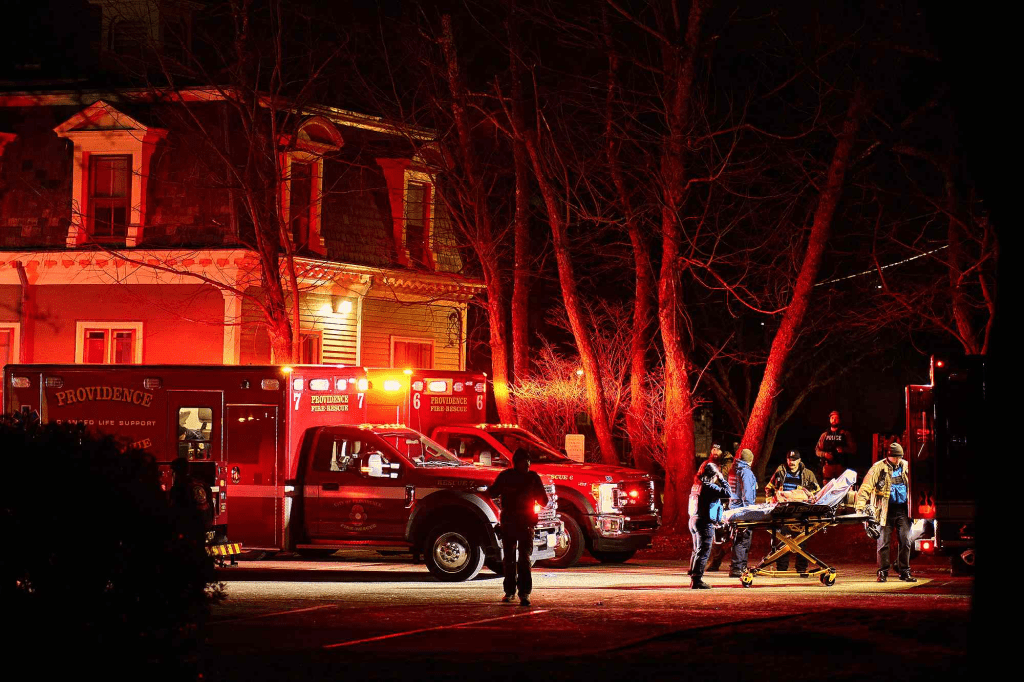
Providence, R.I. — December 14, 2025
A mass shooting at Brown University over the weekend has left two students dead and nine others injured, shattering the sense of security on one of the nation’s most prestigious campuses and reigniting a familiar — and deeply polarized — national debate. But as investigators continue their work, the tragedy also raises uncomfortable questions that many institutions and media outlets appear reluctant to confront.
What Happened
The shooting occurred around 4:05 p.m. on Saturday, December 13, inside Room 166 of the Barus and Holley Building, home to Brown’s School of Engineering and physics departments. The classroom was hosting a final exam review session for a Principles of Economics course — a routine academic gathering during finals week.
According to authorities, the shooter entered the room, reportedly shouted something that remains unclear, and opened fire with a handgun. Two students were killed at the scene. Nine others suffered gunshot wounds or shrapnel injuries. All 11 victims were Brown students.
As of Sunday evening, one injured student remained in critical condition, several others were listed as critical but stable, and at least one had been discharged from the hospital.
The campus was immediately placed under lockdown. Hundreds of law enforcement officers — local, state, and federal — flooded the area, searching nearby neighborhoods and reviewing surveillance footage. The shelter-in-place order lasted overnight and was lifted Sunday morning.
Brown University canceled all remaining fall semester classes, exams, papers, and projects. A community vigil was held Sunday evening in Lippitt Park, where a makeshift memorial continues to grow outside the Barus and Holley Building.
A Suspect — Then a Reversal
In the early hours of Sunday morning, police detained a person of interest: 24-year-old Benjamin Erickson of Cedarburg, Wisconsin, a former Army infantryman described in some reports as a decorated veteran. He was located at a Hampton Inn in Coventry, Rhode Island, roughly 20 miles from campus, after FBI agents used cellphone location data.
Two handguns — a revolver and a Glock-style pistol with a laser sight — were recovered from his hotel room, items that initially appeared to match witness descriptions. His name was widely circulated in media reports within hours.
By Sunday evening, however, authorities announced a stunning reversal: Erickson would be released without charges. Rhode Island Attorney General Peter Neronha said that while there had been “some degree of evidence” pointing toward Erickson initially, further investigation indicated that evidence “now points in a different direction.”
He is not charged, not considered a suspect, and the shooter remains at large. Officials insist there is no active threat to the community, though the investigation remains ongoing with assistance from the FBI.
The episode has left many asking whether law enforcement — or the media — moved too quickly in naming a suspect before the facts were fully established.
Victims, Names, and What’s Missing
As of late Sunday, only one of the two deceased victims has been publicly identified: Ella Cook, a freshman from Birmingham, Alabama. Cook was described by friends and family as a “bright light,” a devout Christian, and notably, the vice president of Brown Republicans.
Her death has received limited attention in national coverage beyond basic biographical details, despite her being a vocal conservative on a campus known for its progressive activism. Several students and alumni have praised her for openly expressing her views and supporting ideological diversity at Brown.
The identity of the second student killed has not yet been released, as family notifications continue. Little has been reported about the injured students beyond hospital status updates.
The Campus Security Question
One fact that has drawn increasing scrutiny: the Barus and Holley Building was unlocked for exam access, allowing the shooter to enter freely. Brown, like many elite universities, operates as a largely “gun-free” campus with limited physical security controls.
Students have already begun circulating petitions calling for mandatory ID swipes on all academic buildings and stronger access controls during high-traffic periods like finals.
Yet broader discussions — such as whether armed campus security, trained response personnel, or other deterrents could have limited the damage — remain largely absent from mainstream coverage. So too is any serious examination of whether gun-free zones actually prevent violence, or simply leave law-abiding students and faculty defenseless when the unthinkable happens.
Mental Health, Not Just Gun Laws
Predictably, many national figures and advocacy groups have used the tragedy to renew calls for stricter gun control, pointing to the timing near the 13th anniversary of the Sandy Hook massacre. But critics argue that rushing to policy talking points before a motive is known risks politicizing grief rather than addressing root causes.
Authorities have acknowledged they are examining possible mental health issues connected to the investigation, as well as the shooter’s background and travel to Rhode Island. If mental illness or untreated psychological distress played a role — particularly given the suspect confusion involving a young veteran — it would underscore long-standing failures in mental health care and crisis intervention.
From a center-right perspective, many argue that enforcing existing laws, strengthening red-flag interventions where appropriate, and improving mental health support — especially for veterans and young adults — may offer more meaningful protection than sweeping new restrictions that primarily affect lawful gun owners.
A Developing Story, and a Call for Restraint
This remains a rapidly evolving investigation. Authorities are urging anyone with information to contact Providence Police at 401-652-5767. The FBI continues to assist, and officials have declined to speculate on motive or identity as evidence is reviewed.
What is already clear, however, is that two young lives were lost, many more were shattered, and a campus community has been forever changed.
As the facts emerge, concerned citizens should demand not only compassion and accountability — but also honesty. That means resisting rushed narratives, examining security failures, addressing mental health gaps, and ensuring that public safety debates are driven by evidence rather than ideology.
In moments like these, the hardest questions are often the most necessary ones.
 New York Bay News
Leave a comment