By Michael Phillips | NYBayNews
New Jersey is making an aggressive play to position itself as a national leader in artificial intelligence, leaning into public-private partnerships, tax incentives, and startup accelerators rather than sweeping new regulations. Supporters say the strategy could revive the state’s innovation legacy. Critics warn that the costs—energy, infrastructure, and public trust—are being downplayed.
A new opinion piece in New Jersey Business Magazine argues the Garden State should “take the risk” and embrace AI as its next big industry. From a center-right perspective, the question isn’t whether AI is coming—it’s whether New Jersey can grow it responsibly without choking innovation or burdening taxpayers.
A Familiar Innovation Playbook
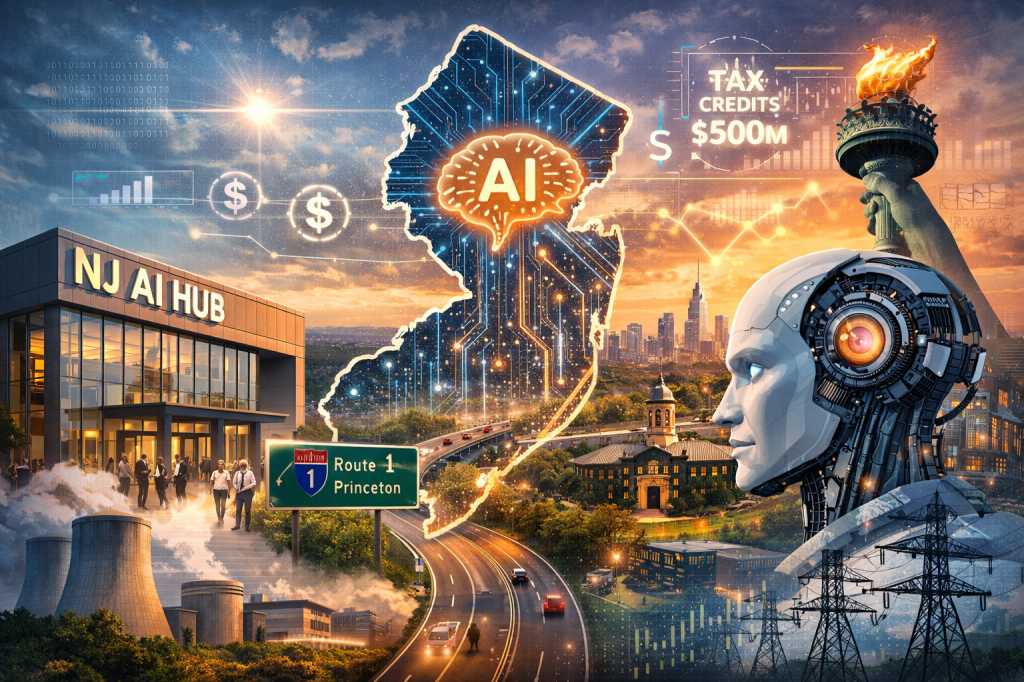
At the center of New Jersey’s AI push is the New Jersey Artificial Intelligence Hub, a public-private partnership anchored near Princeton. Backed by Princeton University, Microsoft, CoreWeave, and the New Jersey Economic Development Authority, the hub has attracted more than $72 million in combined investment for computing infrastructure, research, and workforce development.
State leaders see echoes of earlier successes—Bell Labs, telecom innovation, and the biopharma corridor. Recent announcements, including a $20 million AI startup fund and a new accelerator operated by Plug and Play, reinforce the message: New Jersey wants to be the East Coast alternative to Silicon Valley.
Incentives Over Regulation
New Jersey’s strategy relies heavily on incentives. The “Next New Jersey Program – AI,” signed into law in 2024, authorizes up to $500 million in transferable tax credits for qualifying AI companies and large-scale data centers. Lawmakers are also weighing proposals like Senate bill S4253, which would support AI startups through nonprofit innovation partnerships rather than new regulatory mandates.
This approach aligns with center-right economic thinking: encourage growth, attract capital, and rely on existing laws—fraud, civil rights, consumer protection—to handle abuses. Business groups warn that copying California-style AI regulations could drive investment to friendlier states and disproportionately hurt smaller “Little Tech” startups that lack armies of compliance lawyers.
The Underreported Costs
What receives less attention is the physical footprint of AI. New Jersey already hosts dozens of data centers, and AI workloads dramatically increase demand for electricity and water. Grid operators across the region have warned that data centers are a major driver of rising capacity prices—costs that eventually show up on household utility bills.
Environmental reporting bills requiring energy and water disclosures for data centers have stalled or been amended, amid concerns about ratepayer impacts. These debates rarely make the glossy innovation announcements but are becoming harder to ignore as residents face higher energy costs.
Public skepticism is also real. Recent surveys show that while most residents use AI tools daily, a majority oppose AI making high-stakes decisions in areas like hiring, lending, or criminal justice. Trust, not just talent, will determine whether AI growth sticks.
A Narrow Path Forward
New Jersey’s AI gamble reflects a broader national tension: how to stay globally competitive without losing local control. For now, the state has chosen a light-touch, growth-first approach—betting that innovation, jobs, and research leadership outweigh the risks.
From a center-right view, that bet makes sense—provided lawmakers resist the urge to overpromise and underregulate entirely. Targeted guardrails, transparency around infrastructure costs, and a clear commitment to affordability will matter as much as ribbon-cuttings and venture funds.
AI may indeed be New Jersey’s next big industry. Whether it becomes the next Bell Labs—or the next cautionary tale—will depend on how honestly the state confronts the tradeoffs ahead.
 New York Bay News
Leave a comment