By Michael Phillips | NYBayNews
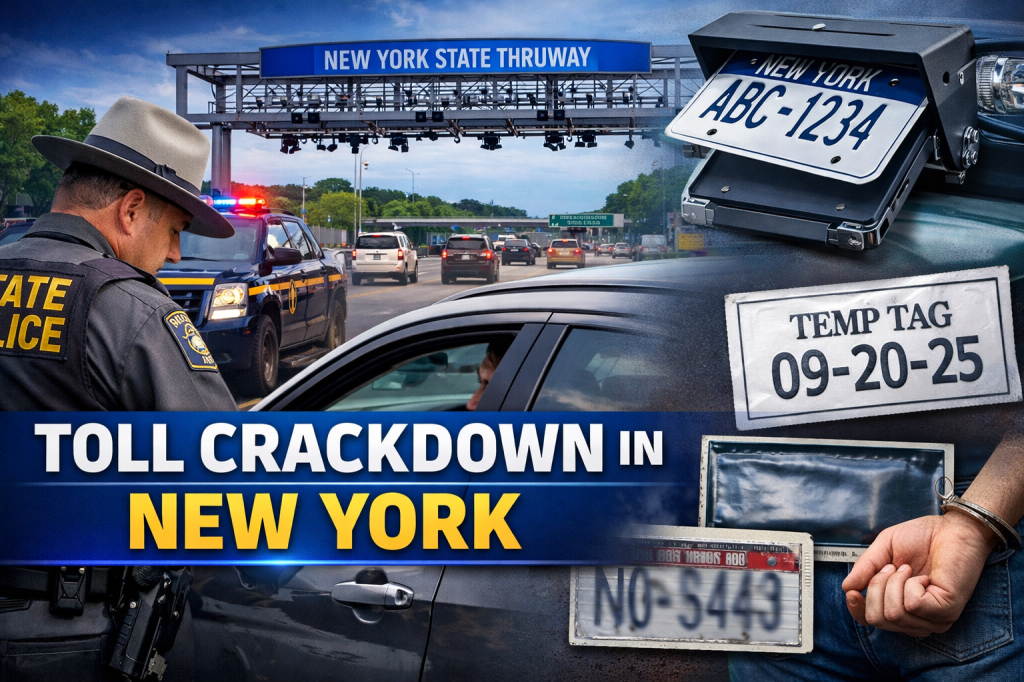
Albany, NY — New York officials are touting the results of a renewed statewide crackdown on toll evasion, announcing that four targeted enforcement operations this fall led to 170 vehicles impounded, more than 1,000 tickets issued, and tens of thousands of dollars recovered from chronic non-payers on the New York State Thruway.
The operations—conducted by the New York State Police Troop T in coordination with the New York State Thruway Authority and the DMV—focused on drivers using fraudulent or obscured license plates, suspended registrations, and other methods to dodge the state’s cashless tolling system.
Governor Kathy Hochul framed the enforcement as a matter of fairness. “Most New Yorkers pay their tolls,” the governor said in a statement. “Those who cheat the system shift costs onto everyone else and undermine funding for critical infrastructure.”
What the Crackdown Found
According to the governor’s office, the fall 2025 operations—carried out in Albany, Syracuse, and twice at the Governor Mario M. Cuomo Bridge—resulted in:
- 170 vehicles seized
- 1,038 total tickets, nearly half for license plate violations
- Arrests tied to DWI, drug offenses, and outstanding warrants
- Roughly $82,000 in unpaid tolls linked to 30 impounded vehicles, with about 46% recovered so far
Officials say these efforts followed a similar summer crackdown, bringing the 2025 total to 310 vehicles impounded and $116,000 recovered from habitual evaders.
State Police Superintendent Steven G. James emphasized the safety aspect, noting that fake or obscured plates make vehicles harder to trace in crashes, hit-and-runs, or other crimes—an argument that resonates beyond toll revenue alone.
The Rise of “Ghost Plates”
At the center of the problem is the explosion of so-called “ghost plates”—altered, fake, or hidden plates designed to fool toll cameras and license-plate readers after New York moved to fully cashless tolling.
Authorities say the tactics range from crude to high-tech:
- Counterfeit or mismatched plates, including paper “temporary tags”
- Tinted or reflective plate covers, tape, stickers, or even mud
- Mechanical plate flippers that hide or swap plates near cameras
- Infrared LEDs or altered digits meant to confuse automated readers
These methods are illegal in New York, with penalties that can include fines up to $500, registration suspension, and vehicle impoundment. Recent budgets also banned the sale of plate-obscuring devices and increased penalties for repeat offenders.
A Fiscal and Policy Debate
The state estimates the Thruway alone loses tens of millions of dollars annually to unpaid tolls, while statewide losses across agencies like the MTA and Port Authority may reach $35–55 million a year. That revenue gap matters as New York embarks on a $2.7 billion Thruway capital plan heavily dependent on toll funding.
From a center-right perspective, the crackdown highlights a familiar tension: strict enforcement versus affordability. While few defend blatant fraud, critics argue that rising tolls and aggressive penalties risk punishing working drivers while failing to address broader cost pressures in a high-tax state.
Supporters counter that enforcement targets the worst offenders—drivers with suspended registrations, no insurance, or vehicles deliberately made untraceable—not occasional late payers. Officials continue to urge drivers to use E-ZPass, which offers significant discounts, or promptly pay tolls by mail to avoid escalating penalties.
Bottom Line
New York’s toll enforcement push underscores a basic principle: systems only work if rules are enforced. Whether the state can balance fairness, affordability, and public safety without leaning too hard on surveillance and penalties will remain a live issue as cashless tolling becomes the norm—and as drivers look for ever-more creative ways to beat the cameras.
 New York Bay News
Leave a comment