
By Michael Phillips | NYBayNews
BOURNE, Mass. — Massachusetts’ long-awaited effort to replace the aging Sagamore Bridge is moving steadily forward, but for a small neighborhood in Bourne, progress comes with a heavy personal price.
The $2.1 billion Sagamore Bridge replacement—part of the broader Cape Cod Bridges Program—has been widely praised as a long-overdue investment in public safety, economic reliability, and regional resilience. Yet as eminent domain proceedings begin in the Round Hill neighborhood, the project underscores a difficult truth about large-scale infrastructure: even necessary public works can exact deep, irreversible costs on individual families.
A Bridge Past Its Breaking Point
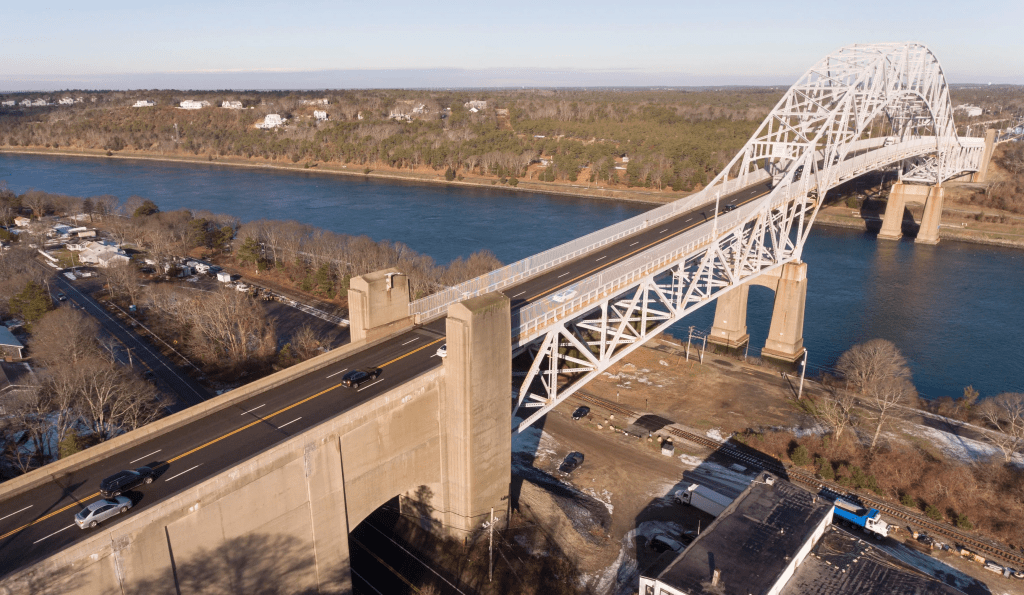
Built in 1935, the Sagamore Bridge was designed for a 50-year lifespan and now carries more than 20 million vehicles annually—nearly double what engineers ever anticipated. A 2020 review by the U.S. Army Corps of Engineers labeled the bridge “functionally obsolete,” citing narrow lanes, the absence of shoulders, and no safe accommodations for pedestrians or cyclists.
State transportation officials argue that replacement—not repair—is the only responsible option. Temporary fixes would likely require repeated lane closures or weight restrictions, potentially choking off access to Cape Cod and harming tourism, emergency response, and local commerce.
The new bridge will be constructed west of the existing span, allowing traffic to continue flowing during the 8–10 year build. Plans call for wider lanes, full shoulders, separated bike and pedestrian paths, and higher clearance to account for sea-level rise—features aligned with modern engineering standards rather than aspirational design.
Eminent Domain Comes to Round Hill
To make the project possible, Massachusetts Department of Transportation is acquiring land in Bourne’s Round Hill neighborhood through eminent domain. Thirteen homes and seven vacant properties will be fully taken, with an additional 17 parcels affected by partial takings for staging areas, drainage, and long-term stormwater management.
For residents, the process is legal—but no less painful.
Longtime homeowner Joyce Michaud, who has lived on Cecilia Terrace for nearly three decades, described the loss of her home as “like a death in the family.” Others, like 82-year-old Dave Collins, will remain but face living beside cranes, truck traffic, and construction noise well into the 2030s, with fears of diminished property values and quality of life.
Perhaps most jarring is the experience of Marc and Joan Hendel, who completed construction of their “dream home” in 2024—only to learn shortly afterward that the state intended to take it. While MassDOT maintains it offered fair market compensation, the couple argues that replacing a custom home with water views and a quiet street is not so easily reduced to an appraisal figure.
The Public Good vs. Private Loss
From a policy standpoint, the Sagamore project reflects a rare example of government actually delivering on infrastructure promises. Nearly $1 billion in federal grants—combined with state funding—has fully financed the bridge before construction begins. Environmental review is nearing completion, and procurement is expected to move ahead later this year, with work starting in 2027 or early 2028.
Support for the project remains strong across the region, especially among business leaders and emergency planners who warn that failure to replace the bridges could one day strand Cape Cod entirely.
Still, the Round Hill cases raise uncomfortable questions. How early should governments be required to warn homeowners? Should compensation reflect emotional and community loss—not just market value? And can large public agencies truly balance efficiency with empathy?
A Necessary Project, Imperfectly Felt
There is little dispute that the Sagamore Bridge must be replaced. The risk of waiting—structural failure, prolonged closures, or catastrophic disruption—would be far worse for the Commonwealth as a whole.
But as Massachusetts pushes forward, the experience in Bourne serves as a reminder: infrastructure may serve millions, but it is built on land where people live, raise families, and plan futures. The challenge for policymakers is not choosing between progress and compassion—but proving that a government capable of spending billions can also take seriously the human cost along the way.
 New York Bay News
Leave a comment