By Michael Phillips | NYBayNews
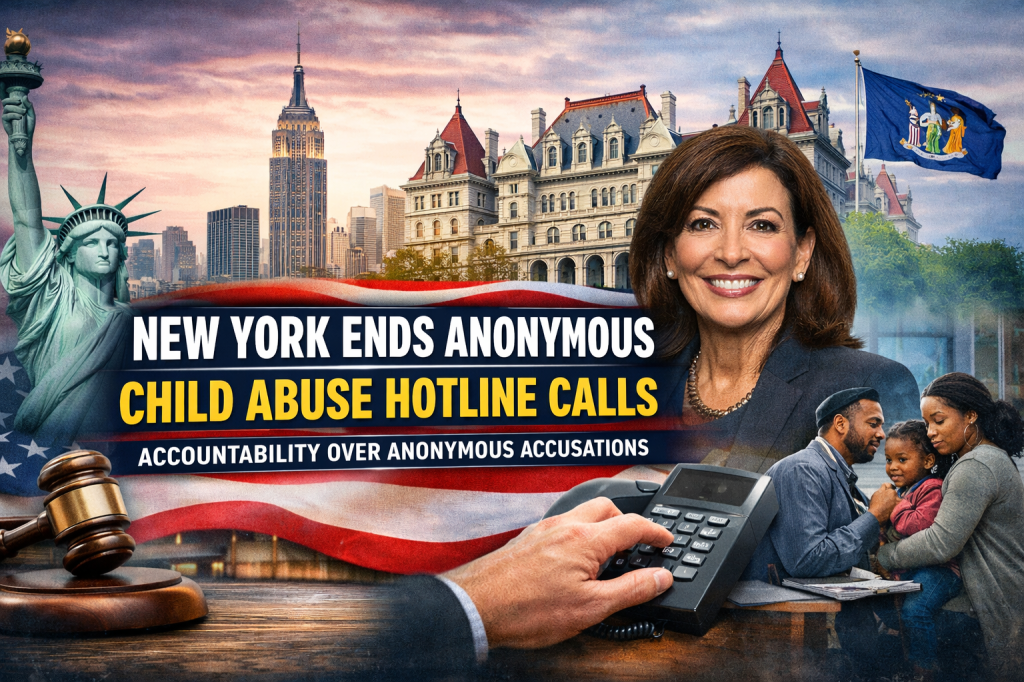
In a quiet but consequential shift, New York is ending fully anonymous child abuse and neglect reports to its Statewide Central Register (SCR) hotline — a move supporters say restores accountability, protects families from harassment, and refocuses child protection on real danger rather than rumor and revenge.
The change comes under legislation signed in December 2025 by Kathy Hochul, known as the Anti-Harassment in Reporting Act (S550A). As first reported by Gothamist, the law takes effect this summer, after training for hotline staff.
Under the new system, callers must provide their name and contact information. Their identity remains confidential, protected by the Office of Children and Family Services (OCFS) and releasable only by court order — but no longer invisible.
From “Anonymous” to “Confidential”
This distinction matters.
Mandated reporters — teachers, doctors, social workers — have always been required to identify themselves. The reform applies primarily to members of the general public, where anonymous calls have long been controversial.
If a caller refuses to provide identifying information, a supervisor must intervene, explain the law, warn about penalties for knowingly false reports, and may redirect the caller to community-based resources such as the HEARS Family Line instead of triggering a child protective investigation.
Why Lawmakers Acted
Supporters argue anonymous reporting has become a tool of harassment rather than protection — particularly in family court and custody disputes.
According to state and federal data:
- Only 7% of anonymous reports in New York City were substantiated in 2023.
- By contrast, over 22% of reports overall — largely from professionals — were substantiated.
- Nationally, 96% of anonymous reports are unsubstantiated.
Yet each report, substantiated or not, can unleash invasive government action: unannounced home visits, child interviews, searches, and family separation threats — often with no wrongdoing ever found.
Advocates describe anonymous reporting as a way for abusive ex-partners, vindictive neighbors, or estranged relatives to weaponize the state against families.
As Washcarina Martinez Alonzo of Legal Services NYC put it, anonymous reporting became “a fancy tool for abusers to continue exerting control.”
A Civil Liberties Issue — Not Just a Family Court One
From a center-right perspective, the reform speaks to core constitutional concerns.
Child protective investigations are among the most intrusive actions government can take against a family — often without warrants, probable cause, or judicial oversight. Critics have long warned that anonymous tips undermine Fourth Amendment protections by enabling government searches based on unaccountable accusations.
Groups across the ideological spectrum — including the New York Civil Liberties Union and the New York State Bar Association — backed the bill, arguing it curbs abuse of state power while preserving genuine child safety.
New York now joins Texas and California, which have also restricted or banned anonymous child abuse reporting, with no evidence so far of increased child harm.
Addressing the Critics
Opponents worry the change could chill legitimate reports, especially from people fearing retaliation.
But supporters counter with several realities:
- Confidentiality remains strong — identities are protected by law.
- Good-faith reporters retain immunity.
- Serious abuse is rarely discovered through a single anonymous call; it usually involves multiple reports or professional observation.
- Anonymous calls have proven overwhelmingly unreliable, while still causing real harm.
An amendment also preserves limited anonymous reporting for minors in sensitive situations.
Why This Matters for Parents — Especially Fathers
For parents navigating family court, particularly fathers who already face heightened scrutiny, anonymous reporting has been a recurring nightmare.
False reports have been used to:
- Gain leverage in custody disputes
- Trigger CPS investigations during litigation
- Create paper trails of “concern” without evidence
For many families, one anonymous call can permanently alter careers, reputations, and parent-child relationships — even when the allegations collapse.
Ending anonymity doesn’t silence whistleblowers. It restores balance by ensuring that accusations carrying the force of the state are made with at least minimal accountability.
A Measured Reform, Not a Retreat From Child Safety
The Anti-Harassment in Reporting Act does not weaken child protection. It strengthens it by:
- Filtering out malicious or frivolous reports
- Freeing resources for real cases
- Reducing racial and economic disparities in investigations
- Reasserting limits on government intrusion into family life
As implementation begins this summer, New York will need to monitor outcomes carefully. But the principle behind the reform is clear: protect children without destroying families based on anonymous claims.
In an era of growing concern about weaponized systems — from social media reporting to family court filings — New York’s move represents a rare moment of bipartisan restraint.
For concerned citizens, and for parents who’ve seen how easily a hotline call can become a life-altering ordeal, that restraint is long overdue.
 New York Bay News
Leave a comment