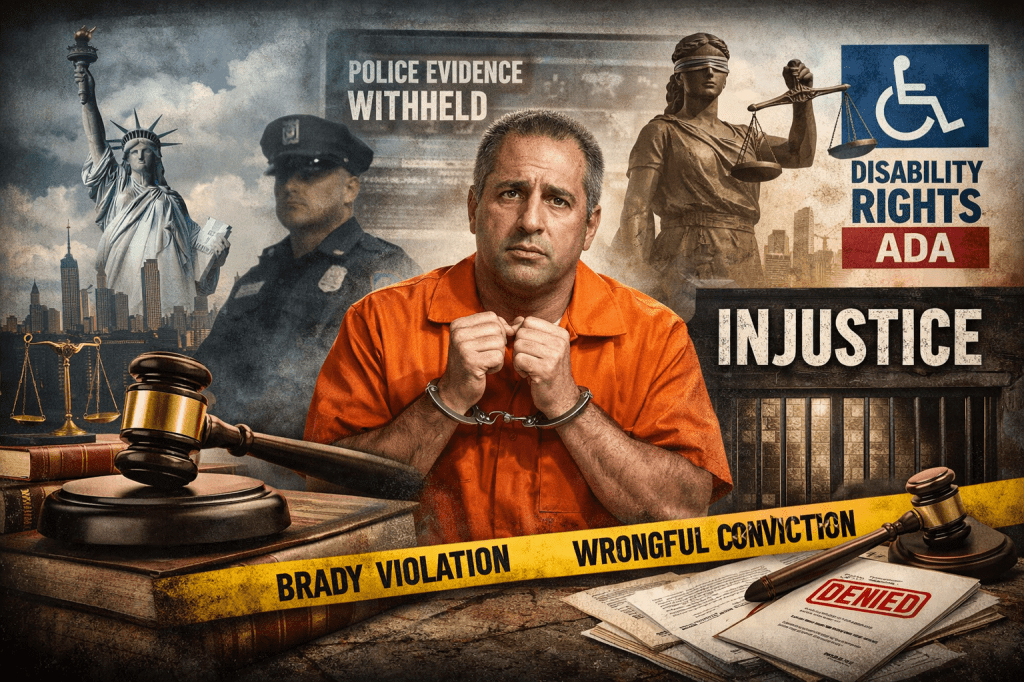
By Michael Phillips | NYBayNews
New York has spent years promoting itself as a national leader on criminal justice reform, disability access, and police accountability. Yet the continued prosecution and sentencing of Marc Fishman, a severely disabled father, exposes a troubling gap between rhetoric and reality.
Fishman is facing a 45-day jail sentence despite sworn police video, radio calls, and internal records showing he committed no crime—evidence that prosecutors failed to disclose at trial.
This is not a disputed factual record. It is documented, on video, and acknowledged by the State of New York itself.
An Arrest That Never Should Have Happened
On December 15, 2018, Fishman was arrested during a court-ordered, prepaid, supervised visitation with his child. A supervisor and a court-appointed disability aide were present. Fishman had a valid visitation order.
The arresting officer later admitted—on police video withheld from the defense—that Fishman had no intent to commit a crime. That evidence was only uncovered years later through federal litigation.
Under longstanding constitutional law, such material must be disclosed to the defense. It was not.
The Arresting Officer Was Later Fired for Pattern Misconduct
In May 2024, New York Attorney General Letitia James designated the arresting officer as “pattern misconduct”, citing false reports and abuse of authority. He was subsequently terminated.
Despite this official finding, the Westchester County District Attorney’s Office, now under DA Susan Cacace, has refused to revisit Fishman’s conviction or address the undisclosed evidence.
The conviction still stands—based largely on the word of an officer the state itself has deemed unreliable.
ADA Failures at the Center of the Case
Fishman lives with traumatic brain injury and neurological impairments that affect communication and cognition. In 2021, the Second Circuit Court of Appeals ordered Westchester courts to provide ADA communication accommodations.
Those accommodations were not reliably provided.
When Fishman sought an emergency stay of his sentence, he was unable to navigate the court’s electronic filing system because of his disability. His attorney was in trial. Despite repeated pleas for assistance, the stay was denied.
The result: a disabled defendant facing incarceration without meaningful access to the courts.
Why This Case Matters
This case raises fundamental questions about due process, prosecutorial ethics, and disability access in New York’s justice system.
If exonerating evidence can be ignored, if official misconduct findings have no effect, and if ADA orders can be functionally bypassed, then oversight mechanisms exist in name only.
Fishman’s case is now before the Appellate Division. It also falls squarely within the mandate of the Commission on Prosecutorial Conduct—an agency created to address precisely this kind of failure.
Whether New York acts will signal whether its reform laws are enforceable—or merely symbolic.
 New York Bay News
Leave a comment