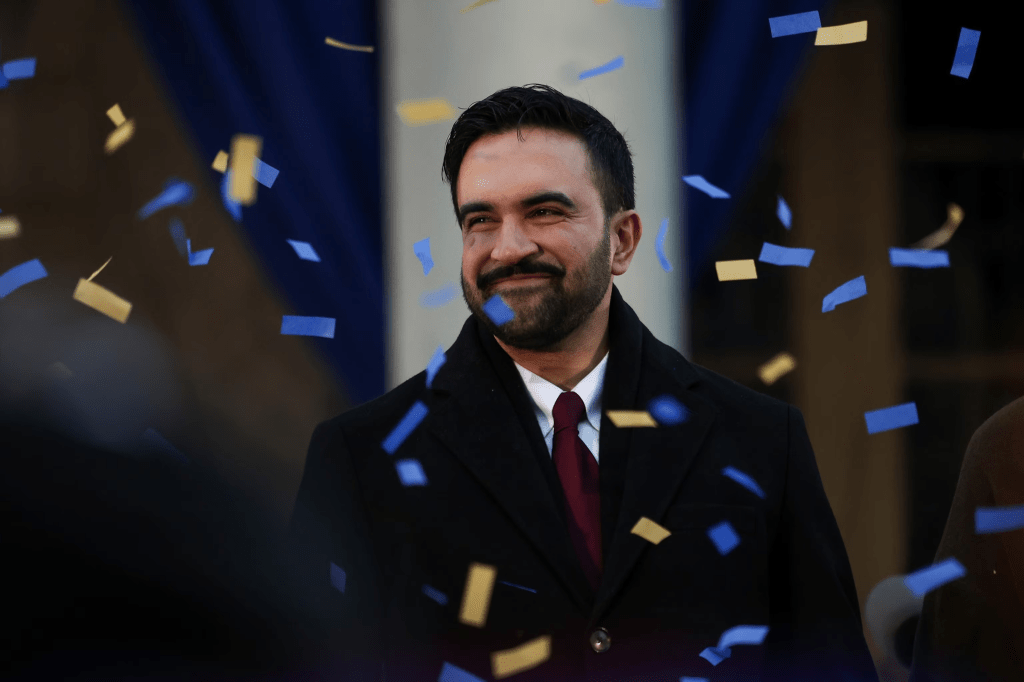
By NYBayNews Editorial Desk
New York City is no stranger to political drama. But even by Gotham’s standards, the first week of Mayor Zohran Mamdani has landed like a thunderclap.
On January 1, Mamdani made history as the city’s youngest mayor in more than a century and its first Muslim mayor. That alone would have guaranteed attention. Instead, what has dominated headlines, cable news, and social media is something else entirely: his unapologetic embrace of democratic socialism—and the ideological shock it sent through large portions of the city and the country.
“I was elected as a democratic socialist, and I will govern as a democratic socialist,” Mamdani declared in his inaugural address, contrasting what he called “the frigidity of rugged individualism” with “the warmth of collectivism.”
For supporters, it was refreshing clarity. For critics—particularly conservatives, moderates, business leaders, and many Jewish organizations—it was a chilling signal.
Rhetoric Before Results
It’s important to separate rhetoric from reality. Mamdani has been in office for barely a week. No mayor could meaningfully implement—or dismantle—major policy in that time. There is no wave of city-owned grocery stores yet, no universal childcare system, no fare-free transit network.
But politics is often about signals, and Mamdani’s signal was unmistakable.
Right-leaning outlets immediately framed the speech as radical. Business groups warned of capital flight. Conservative commentators invoked familiar comparisons to failed socialist experiments abroad. Even some center-left New Yorkers, who may have voted for Mamdani as a protest against the status quo, expressed unease at the tone and ambition of his agenda.
This reaction isn’t just partisan theater. New York’s economy depends heavily on private investment, financial services, real estate, and small businesses—all sectors deeply sensitive to rhetoric about “billionaires,” “elites,” and collective ownership.
When a mayor speaks less about growth and stability and more about redistribution and collectivism, markets listen—even if policies haven’t arrived yet.
The “Broken Promise” Claims—So Far, Thin but Loud
Conservative critics have already begun accusing Mamdani of breaking campaign promises. The most cited example: the MTA fare increase to $3.00 that took effect January 1, despite his “fast and free” transit messaging.
The reality is more mundane. The fare hike was approved months before Mamdani took office and is controlled by the state-run MTA, not City Hall. Still, symbolism matters. For commuters paying more on day one, explanations feel academic.
Other claims—rent freezes, free buses, childcare—remain untested. Most obstacles are structural: state approval, budget constraints, and legal limits on mayoral power. Skepticism about feasibility is fair. Claims of betrayal, at this stage, are premature.
Why the Backlash Feels Bigger Than Policy
The dominant controversy surrounding Mamdani isn’t about what he’s done. It’s about what he represents.
For many New Yorkers who lived through the city’s fiscal crises of the 1970s—or who watched businesses flee high-tax cities in recent years—socialism isn’t an abstract theory. It’s a warning label.
For Jewish communities already anxious about rising antisemitism, Mamdani’s early repeals of certain executive orders and his past rhetoric on Israel have heightened concern, regardless of intent.
For working- and middle-class families, the fear is less ideological and more practical: Will jobs leave? Will taxes rise? Will services actually improve—or just get more expensive?
A City Watching Closely
Mamdani’s supporters argue that New York has tried market-driven governance for decades and ended up with unaffordable housing, strained transit, and widening inequality. They see his victory as a mandate for bold change.
His critics counter that New York’s problems won’t be solved by importing ideology that has repeatedly failed elsewhere—and that governing a $100 billion city budget requires pragmatism, not slogans.
Both sides agree on one thing: the experiment has begun.
For now, the shock is the story. The promises—and whether they hold—will come later.
NYBayNews will continue tracking not just the rhetoric, but the receipts.
 New York Bay News
Leave a comment