By NYBayNews Staff
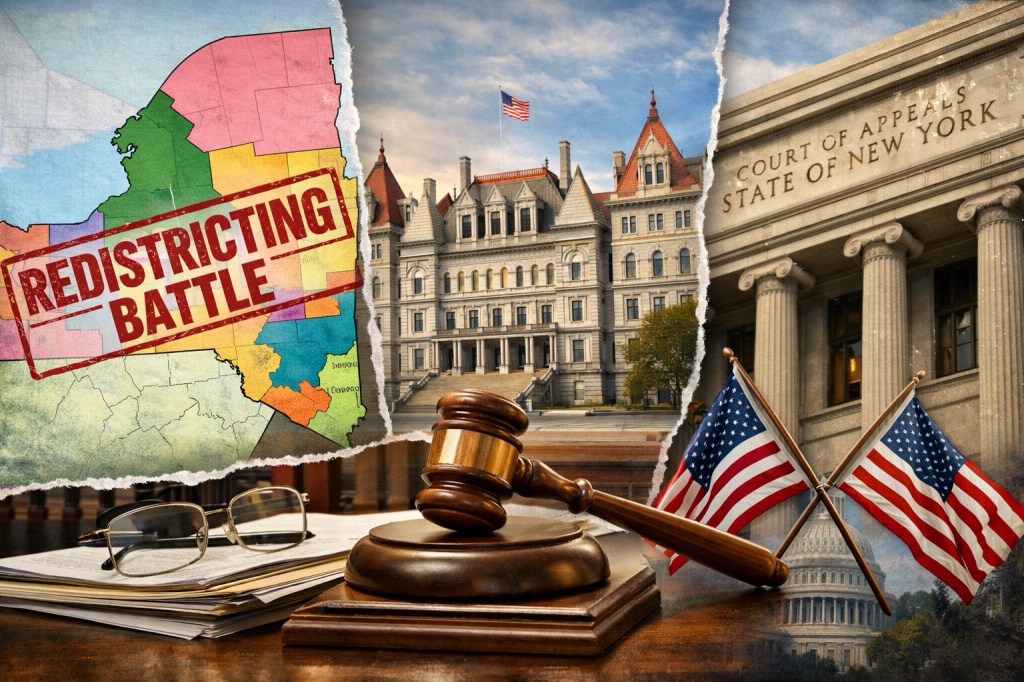
New York is once again staring down the familiar chaos of redistricting litigation—this time after a court ruling reopened questions about who controls the map-drawing process and how much political manipulation voters are expected to tolerate.
According to reporting by Gothamist, a recent decision has pushed the Empire State closer to re-entering the national redistricting fight just as other states brace for similar post-census and mid-decade map battles. The ruling doesn’t just affect lines on a map—it revives a deeper argument about whether New York’s much-touted “independent” redistricting process is independent in name only.
A System Designed to Fail?
New York voters were promised reform a decade ago. The state amended its constitution to create an Independent Redistricting Commission (IRC), marketed as a safeguard against extreme gerrymandering. In practice, the commission has repeatedly deadlocked along partisan lines, sending the final decision back to the Legislature—the very body the reform was supposed to restrain.
That design flaw isn’t accidental. It’s structural. And courts are now being asked, once again, to clean up a mess created by political actors who wrote a system that collapses under pressure.
The latest ruling signals that judges may be willing to scrutinize how far lawmakers can go in bypassing the spirit of voter-approved reforms. But it also raises a troubling question: if courts keep stepping in, is New York governed by constitutional process—or by litigation roulette?
Courts as Mapmakers Is Not Reform
From a center-right perspective, this should worry everyone—not just partisans.
Conservatives have long argued that elections should be decided by voters, not by lawyers, judges, or backroom commissions. When redistricting becomes a perpetual court case, accountability disappears. Legislators blame judges. Judges point to constitutional ambiguity. Voters are left wondering who actually governs.
New York has now joined a growing list of states where redistricting has become a cyclical power struggle rather than a settled democratic function. That instability undermines public confidence and feeds the perception—fair or not—that outcomes are being engineered rather than earned.
The National Stakes
What happens in New York doesn’t stay in New York. As one of the largest congressional delegations in the country, even modest changes to district lines can ripple through control of the U.S. House. That’s why national groups on both sides are watching Albany closely—and why redistricting lawsuits increasingly feel less like state constitutional disputes and more like proxy wars for federal power.
If New York courts signal that mid-cycle intervention is acceptable, expect similar challenges elsewhere. The result? Endless map churn, legal uncertainty, and elections conducted under temporary or court-drawn plans that no one truly owns.
A Better Path Forward
Real reform would mean one of two honest choices:
- Give the commission real authority—with clear tie-breaking rules and limited legislative override; or
- Admit the Legislature controls redistricting, and hold lawmakers politically accountable for the maps they draw.
What New York has now is the worst of both worlds: faux independence, judicial intervention, and zero accountability.
Until that changes, voters can expect more lawsuits, more last-minute maps, and more headlines like this one—each eroding trust in a system already stretched thin.
NYBayNews will continue tracking how this ruling unfolds—and whether New York finally confronts the redistricting fiction it sold to voters, or doubles down on process theater at the expense of democratic clarity.
 New York Bay News
Leave a comment