By Michael Phillips | NYBayNews / Thunder Report
A growing Medicaid fraud investigation in Maine has ignited a broader political fight over government oversight, federal spending, and accountability—one that Maine Republicans say reaches far beyond state borders.
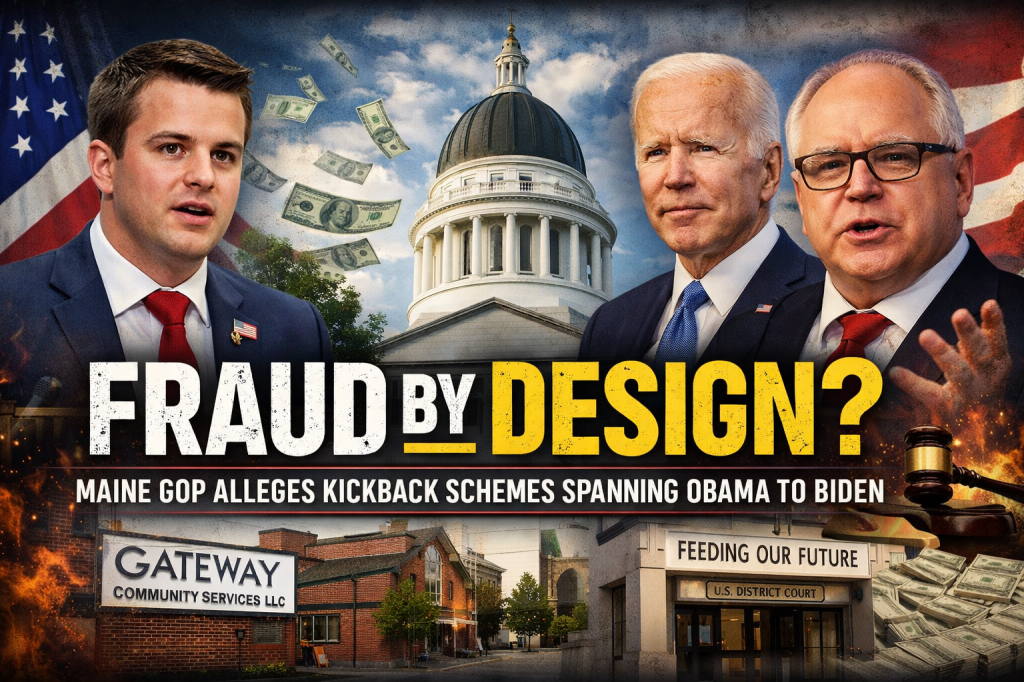
At a December 30, 2025 press conference in Augusta, Trey Stewart, the Republican Minority Leader of the Maine State Senate, accused Democratic administrations stretching back to the Obama era of enabling what he described as a systemic “kickback” culture embedded in federal and state social programs.
“This is fraud by design,” Stewart said. “This wasn’t an accident. It starts at the top with the federal government under the Barack Obama administration, was expanded under the Biden administration, and it runs down to Democratic governors—including Governor Walz and Governor Mills—even to the local level.”
Stewart warned that unchecked abuse of taxpayer-funded programs could lead to what he called a looming “financial Armageddon,” arguing that recent scandals may represent only “the tip of the iceberg.”
The MaineCare Case at the Center
The immediate catalyst for Stewart’s remarks is an ongoing investigation into Gateway Community Services LLC, a Portland-based provider offering behavioral health and interpretation services, largely serving immigrant communities.
According to audits conducted by Maine’s Department of Health and Human Services (DHHS), Gateway overbilled MaineCare by more than $1.7 million between 2015 and 2022. A 2023 audit alone identified over $1 million in improper claims for services not rendered, not covered, or inadequately documented. From 2018 through 2024, the company received an estimated $4–5 million in MaineCare funds.
On December 23, 2025, DHHS suspended payments to Gateway, citing “credible allegations of fraud.” The move led to furloughs and temporary office closures, disrupting services for families relying on behavioral health support.
Federal scrutiny has since intensified. The U.S. House Oversight Committee, chaired by James Comer, has requested bank records and financial documents from Gateway and affiliated individuals. Agents from the U.S. Department of Homeland Security also visited Gateway offices as part of ongoing audits, though no charges or arrests have been announced.
Gateway’s attorney maintains the company is cooperating and has characterized the allegations as politically motivated.
Political Tensions and Oversight Questions
Republicans argue the case exposes broader failures in oversight under Democratic leadership. Stewart and his colleagues have criticized Maine’s DHHS fraud unit as underfunded, noting its annual budget of roughly $1.2 million. They contend warnings went unheeded for years.
Democrats counter that investigations are already underway and caution against politicizing the case or unfairly targeting immigrant communities. Legislative leaders have emphasized that findings should be evidence-based and note that Republicans previously opposed certain funding increases for anti-fraud enforcement.
Governor Janet Mills has offered limited public comment, while DHHS says it is actively working to recoup improperly paid funds.
Parallels to Minnesota
Stewart explicitly linked Maine’s situation to high-profile fraud scandals in Minnesota, particularly the Feeding Our Future case—described by federal prosecutors as the largest COVID-era fraud scheme in U.S. history.
That case involved the alleged theft of approximately $250 million from federal child nutrition programs. As of late 2025, dozens of defendants have been charged or convicted, with only a fraction of the funds recovered. Broader investigations in Minnesota now estimate potential losses of $1 billion or more across Medicaid, daycare, and autism services.
Republicans have accused Minnesota Governor Tim Walz of oversight failures, while Walz has denied wrongdoing, pointing to federal referrals and new anti-fraud initiatives proposed by his administration.
Allegations vs. Evidence
While Stewart’s rhetoric frames these cases as part of a deliberate, top-down scheme benefiting Democratic “social circles,” no evidence has emerged linking Maine’s Medicaid overbilling to kickbacks received by elected officials. To date, investigations have centered on provider conduct, compliance failures, and oversight gaps rather than proven political corruption.
Still, the controversy underscores a growing national debate over the scale of federal spending, the role of nonprofits and contractors, and whether pandemic-era expansions exposed deep vulnerabilities in public assistance programs.
What Comes Next
As of January 2026, investigations in Maine remain active but unresolved. The Maine Attorney General’s office has not confirmed whether it will pursue criminal charges, and federal probes are ongoing. In Minnesota, additional audits and congressional hearings are scheduled in the coming weeks.
For Maine Republicans, the Gateway case has become a rallying point for broader calls to tighten oversight, expand fraud enforcement, and reassess how federal dollars flow through state programs. Democrats warn against drawing sweeping conclusions before investigations conclude.
What both sides agree on is that the outcome could have lasting implications—not just for MaineCare, but for how states nationwide manage and safeguard billions in taxpayer-funded social services.


Leave a Reply